Bubble 2.0
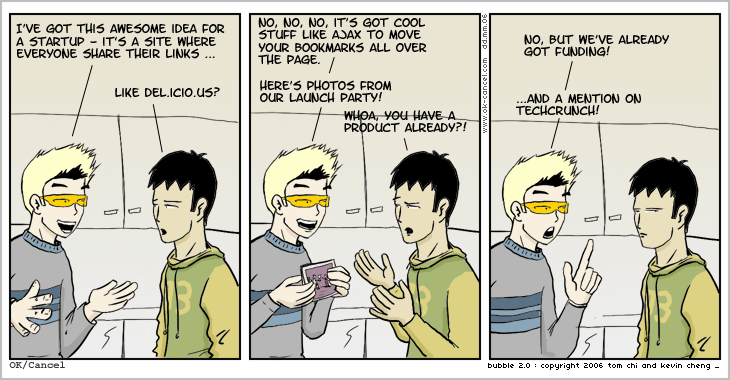
I regard the new tech bubble with a mixture of joy, trepidation, and exasperation.
First let's be clear: it's definitely a bubble. The signs built up slowly:
- Google paid $900 million to advertise on MySpace in August 2006. MySpace had been bought for "just" $580 million a year before, a pretty awesome ROI for News Corp., and a definite early warning sign (Note that the SiliconBeat article, from July 2005, speculates whether the MySpace acquisition is the "peak of the ... web 2.0 wave"). However, both these deals actually made a lot of business sense: the bubbliness was the speed at which the valuation of MySpace had increased. When you build up that kind of momentum, it's hard to stop when you reach the top.
- The next sign that too much momentum had been built up was when Facebook turned down $750MM (allegedly from Yahoo!, but I have no insider knowledge either way). The way advertising-supported web startups work is: you get the idea, you build the site, you get tons of users, and then either Google or Yahoo! or Microsoft acquires you. They then add you to their advertising portfolios, where they make way more money than you could have made on your own, and you get a fat pay-off in a lump sum and can fuck off to your next startup. Ignoring that tested business model is a sure sign of fluffy thinking (or mould-breaking entrepreneurialism, but thinking your Friendster clone is the new Google is another sign of bubbliness).
- Google then quashed any further doubts that the rollercoaster was well underway by getting into a bidding war with Microsoft over DoubleClick, ending up paying $3.1 billion, roughly 10 times DoubleClick's revenue.
- Microsoft made it clear that the rollercoaster was not just underway but already out of control by getting into yet another bidding war with Google and paying $6 billion for aQuantive, or 14 times its revenue. A 40% increase in valuation (relative to earnings) of a near-identical company in less than 30 days?
- And so back to Facebook, which has revealed it does indeed have pretensions to being a platform (i.e. the new Google) by opening up its API to sites-within-Facebook from companies like Twitter, HotOrNot and iLike. When your business model relies on making money by being a platform for tons of other web startups who also have no business models but have lots of VC, you know the bubble is underway.
So this is where the exasperation comes in. Did we learn nothing? Why are VCs such idiots? There was a dark period 2000-2003 when they wouldn't invest in anything because they were scared of Internet-plague. That was almost as dumb as when they'd invest in any damn thing. Then there was a brief Golden Age, roughly 2004-2005, when only startups that were good, had some proven revenue, and knew what they were doing got money. This is when Yahoo! bought Flickr, a deal that became the poster child for good deals: the Flickr founders made money, Yahoo! effectively monetized the site without alienating its user community, and the exposure from Yahoo!'s network boosted membership numbers to Flickr by something like a factor of ten.
But then the VCs saw the money was on the table again, and it became a race to find the hot new shit quickly. And so we have startups getting VC with no visible business model but lots of users, no visible business model and no users either, no differentiation from existing businesses, and even warmed-over flops from the last bubble. It's so stupid.
The Rule of Rule-Breakers
Good ideas are rare, no matter what industry you're in. From what I've seen since 1994, there is pretty much one superstar startup a year -- by which I mean a rule-breaking, game-changing idea, with radically new technology or a new business model:
| Netscape | 1994 |
| Amazon | 1994 |
| Yahoo! | 1994 |
| eBay | 1995 |
| DoubleClick | 1996 |
| Overture | 1997 |
| 1998 | |
| PayPal | 1998 |
| Napster | 2000 |
| MySpace | 2003 |
| and maybe... | |
| Facebook (or will it be Digg?) | 2004 |
| YouTube | 2005 |
| 2006 | |
Sometimes the first mover gets things wrong enough (like Friendster) that a later iteration can take the game (like MySpace, or maybe Facebook -- I feel only one of these is going to emerge triumphant). Sometimes the me-too manages to make it up to the second tier as an acquisition (ValueClick, Oddpost). There are subtleties and quirks, like the death of Netscape, caused by Microsoft throwing around vast, market-distorting amounts of cash. But the rule is pretty clear: you only get to make one bet, not 200.
Hopes and fears
Bubble 2.0 fills me with trepidation because I am, after all, reliant on the web for my livelihood, and the last bubble's bursting left me struggling to find a job just as I came out of university. It even shook some people's faith in the whole idea of the Internet and its technologies as the grand unifying force that I still, deeply and sincerely, believe they will be.
But the fact that the bubble is here at all fills me with a sort of guilty joy. The last time there was a bubble I was eighteen and inexperienced, in the wrong company in the wrong country. I saw just the edges of the bubble, mostly from the outside. This time I'm firmly on the inside, and while it's clear that it's all hype and is going to end badly for the investors... well, I'm not an investor. And for a technologist, the last time was a hell of a lot of fun.
So, officially: here we go again.
* In this category: Geocities (1994), Opera (1995), Urchin (1995), Hotmail (1996), Netflix (1997), eGroups (1998), Blogger (1999), Friendster (2002), Last.fm (2002), del.icio.us (2003), FeedBurner (2003), Flickr (2004) and lots more.